Hierarchical Bayesian models offer a unified framework for understanding both learning and meta-learning — the transfer of abstract knowledge across tasks. We investigate whether these two processes are dissociable through a novel statistical learning paradigm that combines low-level shape pair structures with a higher-order color-based rule. 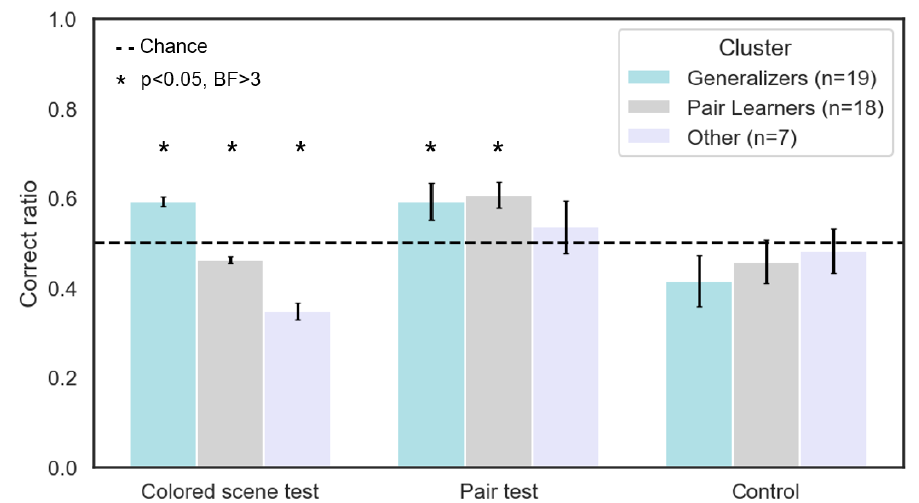 Participants viewed shape scenes organized into covert pairs with consistent color contrast patterns (the pepita rule), followed by tests assessing recognition of both pair-level and meta-structural regularities. Subject-level analyses revealed three learner profiles: (1) those who acquired both low- and high-level structures, (2) those who learned only low-level pairs, and (3) non-learners. Notably, strong low-level learning was a prerequisite for successful meta-learning, aligning with predictions of hierarchical models. These findings support a behavioral dissociation between learning and meta-learning and highlight individual differences in abstract knowledge acquisition and transfer.